

Product
제품

- TRU Resin
- 제품명: TRU Resin
- 용도: Fe, Th, Pa, U, Np, Pu, Am, Cm Separation
- 메이커: Eichrom Technologies
- 카달로그:

소개

TRU Resin
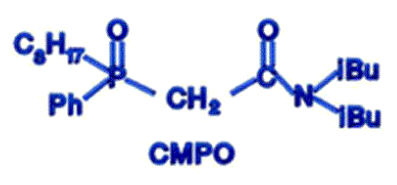
CMPO molecule
Eichrom의 TRU Resin은 octylphenyl-N,N-di-isobutyl carbamoylphosphine oxide(CMPO)를 tri-n-butyl phosphate(TBP)에 용해시켜 불활성 지지체에 담지한 추출 크로마토그래피 레진입니다. TRU Resin의 충전층 밀도(Bed Density)는 약 0.37 g/mL이며, 작업 용량(Working Capacity)은 레진 1 mL당 아메리슘(Am) 2 mg 또는 2 mL 프리패킹 컬럼당 4 mg입니다. 이는 레진의 이론적 최대 적재 용량의 약 20%에 해당합니다.
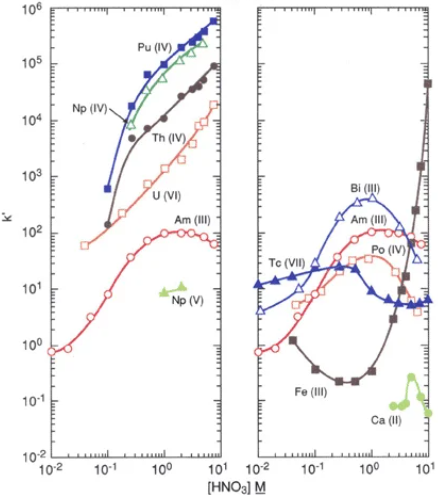
Acid dependency of k’ for various ions at 23-25℃. Horwitz, et al.
Figure shows the uptake of various actinide elements from nitric acid solutions by the TRU Resin. The y-axis, k’, is a measure of uptake, corresponding to the number of free column volumes (FCV) to peak maximum in a chromatographic column. FCV is a measure of the interstitial space (or void volume) of a column. Values higher than 100 indicate strong uptake, values between 1 and 50 indicate weak uptake. The data presented here was generated by Horwitz, et al. at Argonne National Laboratory using experimental batches of TRU Resin. Eichrom’s commercial product conforms to established specifications that ensure proper performance of Eichrom issued methods. Please refer to our product specifications for details.
The tetravalent actinides show extremely high retention on the column, with k’ in the range of 10E4-10E6 at HNO3 concentrations in excess of 2M. Hexavalent uranium is approximately one order of magnitude lower. The k’ curve for trivalent americium plateaus at about 100 FCV in the range of 1-5M nitric acid. It is important to note that trivalent plutonium behaves similarly to americium and that pentavalent neptunium exhibits very low retention at any nitrate concentration.
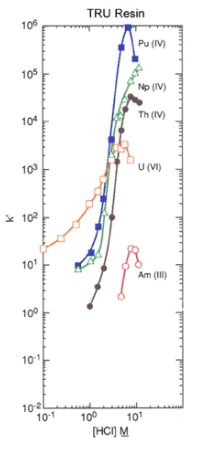
Figure shows the retention behavior of the actinides in HCl. The very low affinity of the column for Am in chloride media forms the basis for the selective stripping of Am (and trivalent plutonium) from the TRU Resin.
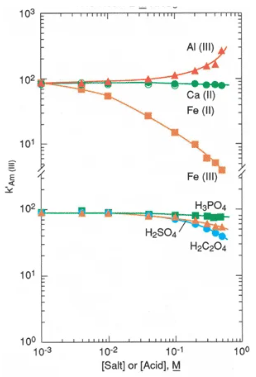
Effect of Matrix Constituents on Americium Retention TRU Resin 2 M HNO3. Horwitz, et al.
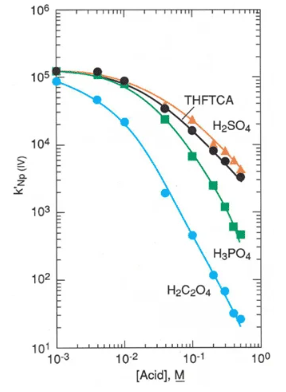
Effect of Matrix Constituents on Neptunium Retention TRU Resin 2 M HNO3. Horwitz, et al.
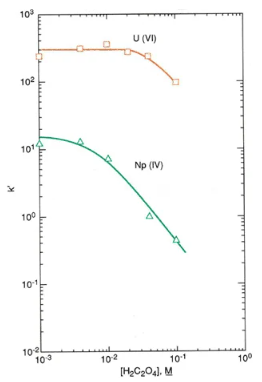
Effect of Oxalic acid on k’ of Np(IV) and U(VI) in 1 M HCl. TRU Resin HCl. Horwitz, et al.
Figures show the effect of a number of matrix components on the uptake of the actinides on TRU Resin. The effects of various cations and complexing anions on the retention volume (k’) of americium in 2M nitric acid on the TRU Resin are plotted in Figure. Among the cations shown, calcium and divalent iron show no effect on americium retention. This is particularly valuable since both calcium and iron are present in large quantities in many environmental and bioassay samples. They are often added as carriers in precipitation steps. Trivalent iron shows a significant, negative effect on Am retention. If it is suspected that iron is present in a sample, a reducing agent such as ascorbic acid should be added to ensure that all Fe(III) is reduced to Fe(II). Ammonium thiocyanate can be used as an indicator for this; it is a deep red color in the presence of Fe(III) and colorless in the presence of Fe(II). The effect of Fe(III) on Am retention will increase at higher HNO3 concentrations, where Fe(III) is more strongly retained.
As shown in Figures 23 and 24, the commonly occurring polyatomic anions show a relatively small effect on americium retention on the TRU Resin, but have a significant adverse effect on the retention of the tetravalent actinides. While Figure 24 shows only the effects on the retention of neptunium, the behavior of the other tetravalent actinides under the same conditions is analogous. The curve for plutonium is nearly identical to the neptunium curve; that for thorium would be parallel, but approximately one order of magnitude lower.
Fortunately, the retention of neptunium and plutonium is high enough that even relatively large concentrations of sulfate and phosphate (up to 0.5M) should not cause breakthrough under the conditions indicated in our published methods. If thorium is being separated on TRU Resin, care should be taken for samples with elevated levels of phosphate or sulfate. The addition of aluminum nitrate will reduce the matrix effect as phosphate will complex the aluminum preferentially leaving thorium less affected.
As shown in Figure 25, the effect of oxalate is quite significant for the tetravalent actinides, which readily form oxalato complexes that are not extracted by the CMPO/TBP solvent system. Uranium retention is not affected significantly by oxalate up to 0.1M. . For this reason, solutions of oxalate salts can be used to strip tetravalent actinides selectively from the TRU Resin without eluting uranium.
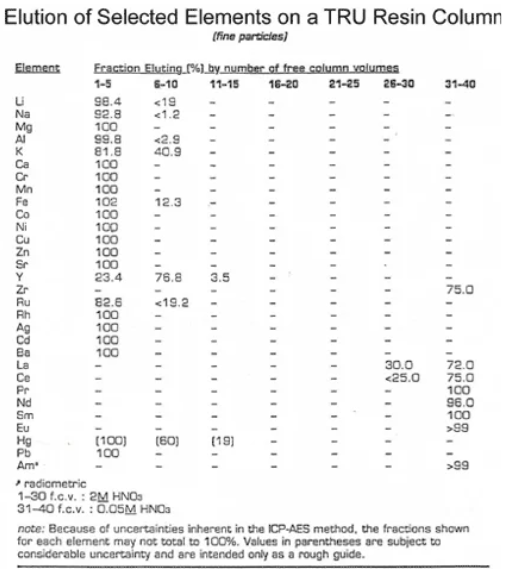
Lists the elution behavior of a number of commonly occurring elements on the TRU Resin in 2M nitric acid (FCV 1-30) and in 0.05M nitric acid (FCV 31-40.)
주문정보
| Particle Size | Bottles | Part Number |
|---|---|---|
| 100 - 150 μm | 25 g | TR-B25-A |
| 50 g | TR-B50-A | |
| 100 g | TR-B100-A | |
| 200 g | TR-B200-A | |
| Columns (2 mL) | Part Number | |
| Package of 50 | TR-C50-A | |
| Particle Size | Bottles | Part Number |
| 50 - 100 μm | 25 g | TR-B25-S |
| 50 g | TR-B50-S | |
| 100 g | TR-B100-S | |
| 200 g | TR-B200-S | |
| Cartridges | Part Number | |
| 1 mL, Package of 50 | TR1ML-R50-S | |
| 2 mL, Package of 50 | TR-R50-S | |
| Particle Size | Bottles | Part Number |
| 20 - 50 μm | Per gram (10 g minimum) | TR-B01-F |